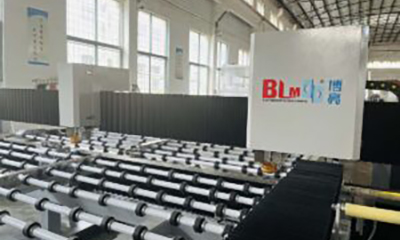
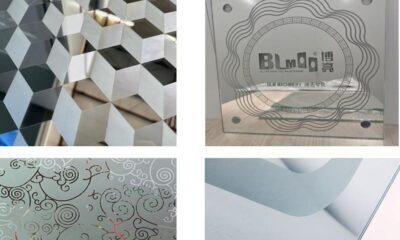
The precision glass processing industry is undergoing a structural transformation. For decades, traditional mechanical drilling was the primary method, yet it often hit a “physical wall” regarding edge quality and consistency. Today, the integrated glass laser drilling machine is redefining these boundaries, with glass laser drilling moving from a specialized tool to a mainstream industrial platform.
Introduction
Traditional glass drilling relies on diamond bits and physical contact. This approach faces two critical pain points:
- Edge Bursting and Micro-cracks:Glass often cracks or bursts at the edge during drilling due to the mechanical stress and heat generated by the friction between the drill bit and the material. This force can exceed the structural tolerance of the glass, resulting in edge bursting.
- Consistency vs. Multiple Clamping:Every time a glass piece is placed under clamp again – this happens during tasks such as sanding or peeling film-small misalignments build up. Because each step alters position slightly, overall precision tends to drop across repeated adjustments.
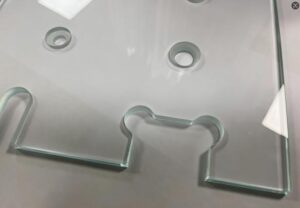
This is why laser drilling glass has emerged as the superior alternative, offering a non-contact, high-precision solution that maintains the material’s integrity.
The Core Technical Logic of Infrared Laser Drilling
Precision Through Focused Energy
Infrared (IR) lasers achieve “precision hole formation” by focusing energy into a microscopic area. This creates a localized thermal effect that removes material in micro-zones, allowing for complex geometries and ultra-fine diameters that mechanical tools cannot achieve.
System-Level Accuracy Control
To achieve incredibly accurate positioning, infrared laser drilling systems rely on a few key technologies:
- CNC Control Systems:These systems use advanced numerical controls to guide the laser’s movements. The precision of each pulse of the laser is controlled down to fractions of a millimeter, ensuring that every hole is drilled exactly where it’s needed.
- High-Stability Laser Sources:A stable energy output is critical for maintaining consistent quality in the holes. If the energy fluctuates, it could cause inconsistencies in hole size and shape. High-stability lasers deliver a steady, uniform output to avoid this issue.
- Structural Rigidity:What keeps the laser steady must be rock solid. Tiny shakes might shift where it aims. Top-tier gear, such as TBI guide rails, builds that firmness – no wobble while running. Machines that work accurately hold their position without drift, locking the beam right where it needs to go.
What holds everything together is how tightly each part fits into the next, building a setup that pins down tiny hole positions within just 0.02 millimeters of error.
Such tight margins matter deeply across fields – cars, computer chips, telecom gear-all leaning hard on accuracy to function right.
What is an Integrated Glass Laser Drilling Machine?
An “integrated” machine is more than just a laser; it is a one-stop processing platform that consolidates multiple workflows.
The Meaning of “Integration”
- Process Consolidation:Such a machine offers a “Laser Drilling + Automatic Sanding / Film Removal” solution.
- Hardware & Software Synergy
Hardware: Features automatic loading, precision alignment, and waste collection.
Software: Supports direct DXF/graphical imports and automatic path planning, often connecting directly to factory ERP systems for intelligent management.
The Role of Infrared (IR) Lasers
The Infrared lasers have advantages in the following aspects::
Stability: It is mature and highly adaptable to industrial environments.
Versatility: Ideal for glass thicknesses ranging from 0.5mm to 20mm.
Scale: Best suited for large-sized glass and continuous, high-volume production.
Comparison: Integrated Laser vs. Traditional CNC
|
Feature |
Traditional CNC Drilling |
Integrated Glass Laser Drilling Machine |
|
Contact Method |
Physical contact (Friction) |
Non-contact (Laser pulse) |
|
Consumables |
High (Drill bits wear out) |
Zero (Laser source has long life) |
|
Edge Quality |
High risk of cracks/bursting |
Clean edges, minimal micro-cracks |
|
Flexibility |
Limited by bit size |
High (Any shape via software) |
|
Workflow |
Often requires secondary cleaning |
One-stop (Drill + Sand + Film Removal) |
The Glass Drilling & Sandblasting & Film Removal Machine from BLM Automatic Machine integrates advanced laser technology for precise drilling, sandblasting, and film removal in a single process.
This system ensures high efficiency and accuracy, while being environmentally friendly and consumables-free.
Why Integration is Replacing Segmented Processing
The shift toward the integrated glass laser drilling machine is driven by three structural advantages:
- Efficiency:Completing drilling and film removal on one machine reduces “transfer time” between stations.
- Quality Consistency:By using a single positioning event for multiple processes, the machine eliminates the error accumulation caused by repeated clamping.
- Long-term Cost Control:Maintenance shifts from “tool management” to “system maintenance.” There are no tools to replace, making it ideal for high-volume, automated production lines.
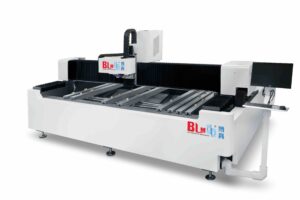
img.integrated glass laser drilling machine.jpg
Industries Leading the Adoption
- Electronics & Display:Used for panel glass and functional holes where edge quality is non-negotiable.
- Photovoltaic (Solar):Requires high-speed, stable processing for energy-harvesting glass.
- Automotive:Perfect for sensor and installation holes in complex curved glass.
- Architectural & Furniture:Handles large-scale glass for curtain walls and shower rooms with multi-hole layouts.
Evaluating a High-Quality Laser Drilling Machine
When selecting equipment, look for these benchmarks:
- Precision Standards:Does the machine utilize a high-precision gantry and quality components like Siemens or Schneider electronics?
- Software Compatibility:Can it read barcodes/QR codes and sync with ERP systems?
- Service Ecosystem:High-quality providers like BLM Automatic Machine offer a “2-7-24” rapid response system, ensuring that faults are addressed within 24 hours to minimize production loss.
Conclusion
Precision glass processing is moving from “mechanical limits” to “laser platformization.” For enterprises pursuing efficiency and zero-defect production, the integrated glass laser drilling machine is the essential upgrade path.
Improve the precision and efficiency of your glass processing with BLM Automatic Machine’s laser drilling solutions. Our technology delivers high accuracy, consistent results, and seamless automation, optimizing your production line for reliable and efficient glass manufacturing.
FAQ
Q: Why is laser drilling better than mechanical drilling for thin glass?
A: Since laser drilling doesn’t touch the glass, there’s no force pushing against it. That setup lowers the chance of breaking or tiny fractures – especially in delicate layers.
Q: Can these machines handle different glass thicknesses?
A: Yes, integrated machines typically support a wide range, from 0.5mm to 19mm or more, by adjusting laser parameters via the CNC system.
Q: Does laser drilling require water cooling like traditional drills?
A: While the laser source itself requires cooling, the “drilling” process doesn’t require the massive water lubrication needed for diamond bits, leading to a cleaner workspace.
Q: How do integrated machines improve automation?
A: They feature automatic loading/unloading and can be connected to robotic arms or factory ERP systems to realize a fully automated production line.
Q: What is the maintenance cycle for a laser drilling machine?
A: Unlike CNC drills that need daily bit checks, laser machines focus on system calibration and lens cleaning. BLM Automatic Machine supports this with a professional after-sales system.