
Glass processors rarely lose efficiency because they cannot drill a hole. The real problem appears when one production day includes different hole diameters, milled notches, large architectural panels, shower glass, coated glass, and short-run orders that change from sheet to sheet. Every manual tool change, repeated positioning step, and transfer between machines adds time and creates another chance for error.
At GlassBuild America 2026, BLM Automatic Machine will present three processing routes for this challenge: a multi-spindle drilling and milling machine, a vertical drilling and milling machine, and an integrated laser drilling, sandblasting, and film removal machine. The key question is which process matches the production mix.
We have worked in glass deep-processing machinery since 2007. The factory area is about 10,000 square meters, with ISO 9001 management and CE-related compliance for glass drilling and laser equipment.
Why Mixed Orders Slow Down Glass Processing
A conventional drilling machine performs well when glass dimensions and hole patterns remain stable. Mixed orders are different. One sheet may need two 12 mm holes, the next may require larger holes plus a notch, and another may call for several machining positions.
For this reason, high-speed glass drilling should not be judged only by spindle speed. Real productivity depends on the full cycle: drawing import, positioning, tool selection, drilling, milling, unloading, and changeover.
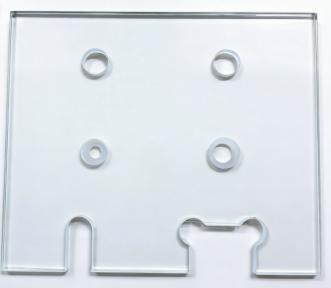
Precision glass drilling also has to be considered together with milling. Drilling creates circular holes, while milling expands the process to slots, cut-outs, and notches. When both operations are completed in one CNC drilling and milling machine for glass, the sheet does not need to be transferred and positioned again on a second machine. This reduces handling and helps maintain positional consistency.
That same logic should guide automatic glass machine sales and automatic glass machine supply. A machine with a high nominal speed may still become a bottleneck if operators spend too much time changing tools or entering coordinates.
A98 for Scattered Orders and Flexible Production
Multi-Spindle Drilling with Milling Capability
For scattered orders and multi-specification production, the A98 drilling, milling, and polishing platform is designed around flexibility. The Spindle 8+8 configuration provides 16 drill-bit positions, allowing different hole diameters to be selected without repeated manual tool replacement.
The documented processing range reaches 6000 × 2500 mm. It handles 4–19 mm glass, with drilling diameters from Φ6 to Φ50 mm. Minimum glass size is 1200 × 300 mm, and the operating reference height is 900 ± 20 mm.
These specifications matter because scattered-order production rewards quick switching more than long repetitive runs. The A98 can move between different drilling requirements while keeping positioning and program control within one system. The Y1 machine head includes a milling-cutter function, so the machine is not limited to circular-hole processing.
İçin hassas cam delme, machine rigidity also matters. The main beam uses thick steel plate, and the frame passes through welding, annealing, gantry milling, sandblasting, rust removal, and painting. Automatic lubrication, high-precision racks, servo drive, and protected guide systems support long-term positioning stability.
Digital Workflow for Faster Changeovers
The industrial computer can connect with ERP, barcode scanning, online drawing, and CAD or DXF files. This reduces repeated data entry and speeds changeovers.
The A98 can also work as a standalone machine or connect with double edging machines, washing equipment, and ERP systems for online scanning. This is important when evaluating automatic glass machine supply because line efficiency depends on integration, not only on one machine’s standalone cycle time.
A71X for Vertical Drilling and Milling
Compact Layout for Large Glass
When factory space and large-panel handling are the main concerns, the A71X provides a vertical solution. It combines automated conveying, CNC control, suction-cup positioning, automatic tool change, drilling, and milling in one vertical structure.
Depending on specification, the series covers glass sizes from 2500 × 1500 mm up to 6000 × 3000 mm. It processes 4–19 mm glass and Φ6–Φ50 mm holes, with an electric spindle speed of 12,000 rpm. Tool-holder configurations are 6×2 or 8×2.
For high-speed glass drilling, automatic tool change is valuable because speed is lost when operators must stop production to replace drills manually. The BT40 tool-holder system allows several tool diameters to be prepared in advance.
Milling changes how the glass must be restrained. During milling, two vertical rows of wheels press the glass securely, while rack-and-guide-rail mechanisms control suction-cup and machine-head movement. This support matters because milling introduces lateral force.
The A71X is suitable for shower glass, architectural glass, railings, curtain walls, door glass, and furniture glass. For customers comparing automatic glass machine sales options, the choice between A98 and A71X should be based on order structure, panel size, floor-space limits, and production layout.
When Laser Processing Is the Better Route
Drilling, Sandblasting, and Film Removal Together
Mechanical drilling is not always the best solution. For coated glass, Low-E glass, mirror products, decorative processing, or selective film removal, a laser drilling machine for glass can combine several processes on one platform.
The GLM-2512 integrated system combines laser drilling, sandblasting, and film removal. Its working area is 2500 × 1200 mm, specified accuracy is ≤0.02 mm, and glass thickness range is 0.5–20 mm. The infrared MOPA laser provides adjustable power from 140 to 300 W at 1064 nm. Maximum drilling diameter is 100 mm, while sandblasting width and film-removal width reach 100 mm.
A laser drilling machine for glass also requires different maintenance priorities. Optical components must be protected from dust and debris, so the system uses enclosed protection, precision guide-and-rack motion, servo drives, industrial cooling, and synchronized dust extraction.
Laser does not replace every Cam için CNC delme ve frezeleme makinesi. Mechanical systems remain effective for standard holes, notches, and milling on architectural and shower glass. Laser becomes attractive when drilling must be combined with surface treatment or coating removal.
See the Technology at GlassBuild America 2026
GlassBuild America 2026 will take place September 23–25, 2026, in the West Building of the Las Vegas Convention Center in Las Vegas, Nevada. Visit Booth 3776 to see a multi-spindle drilling and milling machine, a vertical drilling and milling machine, and a laser drilling, sandblasting, and film removal machine.
For project evaluation, bring your glass dimensions, drawings, hole patterns, milling requirements, and current cycle-time problems. For automatic glass machine sales or automatic glass machine supply discussions, contact Abby Xie at +86 13923225217.
Talk to Us at Booth 3776
BLM Automatic Machine can help determine whether A98 scattered-order processing, A71X vertical processing, or a laser drilling machine for glass is the right route for your production.