A shower glass panel can leave the edger on time and still spend its next journey waiting. The drilling station needs another program, the following panel needs a cutout, and the washer stands idle. For factories handling mixed orders, the challenge is keeping each panel moving through connected machines with its correct processing instructions.
The Process Route Behind a Connected Line
A practical fabrication route links edging, drilling or milling, then final washing and drying. Edging establishes the required perimeter finish; drilling creates holes, while milling handles specified cutouts when the machine has that capability. Final cleaning follows these operations so the panel reaches its next process without carrying their surface residue forward.
The connection becomes useful when it removes a repeated handling or information handoff. A cnc glass machine can belong to an automated line, but its control system alone does not establish compatibility with the equipment on either side. Transfer height, glass orientation and the receiving station’s readiness still need to agree.
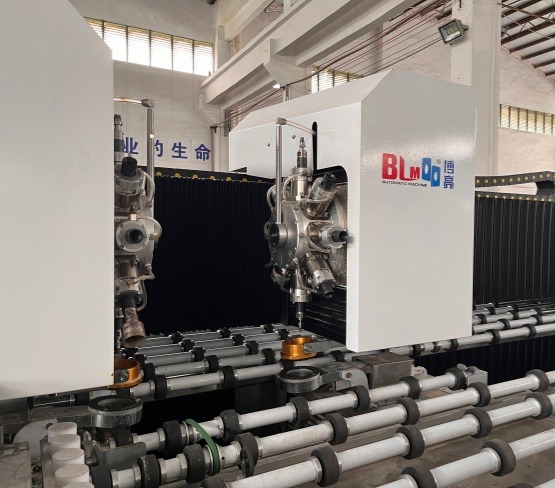
Factories processing scattered orders need a drilling station that can accommodate changing hole patterns within that route. BLM Automatic Machine’s A98 can operate independently or connect with a double edger, washing equipment and factory ERP. This makes it a relevant integration option, with the final arrangement dependent on the selected configuration and surrounding machines.
A Shared Working Range for Every Panel
The usable line range is the overlap between its stations. A drilling machine may accept a wide sheet that cannot pass through the washer, while a small panel may need transfer support even when both machines can process it separately. Compare the complete panel journey before treating individual maximum sizes as line capacity.
The A98(6025) and QX2.5 normal-glass washer illustrate the checks involved. These figures support an initial compatibility review; they do not establish a commissioned production line.
|
Interface |
Available figures |
Meaning for the line |
|
Panel width |
A98 maximum sheet: 6000 × 2500 mm; QX2.5 maximum width: 2500 mm |
Width matches on paper; confirm entry orientation and length support. |
|
Espessura de vidro |
A98: 4–19 mm; QX2.5: 3–19 mm |
Their shared stated thickness range is 4–19 mm. |
|
Transfer height |
A98 operating height: 900 ± 20 mm |
Measure adjoining conveyors and agree the final transfer level. |
Small panels require a separate check. The A98(6025) minimum sheet is 1200 × 300 mm, whereas the QX2.5 minimum is 300 × 450 mm with diagonal entry. Those different entry conditions cannot be treated as automatic proof that the smallest A98 panel transfers directly into the washer.
Changing Hole Patterns Change the Line Rhythm
Mixed orders make cycle time depend on the work each panel needs. Count positioning, machining, tool changes and transfer when timing the drilling station. A comparison based only on conveyor speed misses the periods when glass must remain in position for processing.
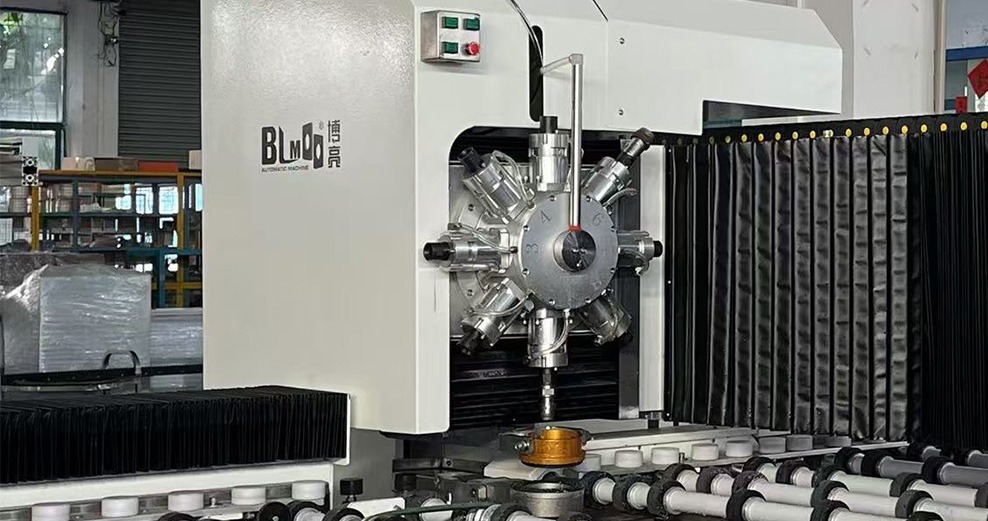
The A98 rotary magazine can carry 16 types of drill bits and switch between diameters. That capability is useful when consecutive panels require different holes. However, a panel needing several operations still deserves its own timing check; magazine capacity is not a guaranteed hourly output.
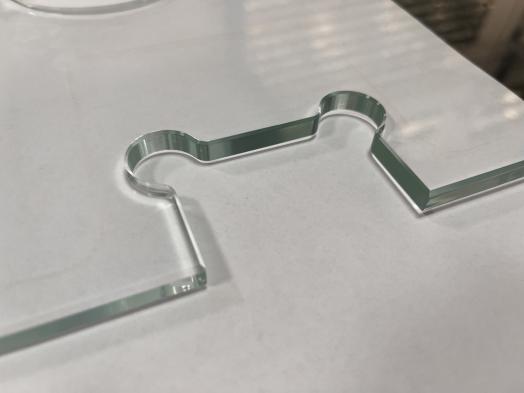
A máquina de molhamento de vidro function also changes the workload. Milling is optional on the standard A98, while the A98(8X) includes a milling cutter in its Y1 head. Confirm the actual version before planning to combine drilling and cutout milling at this station.
A representative trial should include simple hole patterns, several diameters and any required milled cutouts. Record where panels queue and where equipment waits empty. Use those observations to decide whether controlled spacing or a buffer is needed, and size that arrangement around supported glass handling rather than an assumed production gain.
The order sequence should remain realistic during this trial. Alternate the panel types that normally arrive together instead of testing only identical sheets. Keep a separate record of machining time and time waiting for permission to transfer, so the team can identify which handoff needs adjustment.
Washing Speed Follows the Work Arriving Upstream
The washer has to receive the real production mix. The QX2.5 has a stated transport-speed range of 0.5–8 m/min, but that is not a pieces-per-hour rating. Panel length, spacing and the validated cleaning setting all affect how many panels can pass through.
An automatic glass washer therefore needs evaluation at the speed that produces the required clean, dry surface. Simply raising its speed cannot recover time lost at a drilling bottleneck. During the connected trial, check transfer stability and the finished surface after both simple drilling jobs and longer milling jobs.
The Barcode Must Stay With the Correct Panel
Information continuity matters once different jobs share the same conveyor. The A98 industrial computer supports barcode scanning, drawing import and ERP connection. CAD and DXF drawings can be transferred to its computer, reducing the need to enter the same geometry again at the machine.
Reliable job identification still needs a defined workflow. Agree which drawing revision belongs to each panel, which edge establishes its orientation, and what happens when a code cannot be read. Test the response to a missing code or a removed panel before releasing unattended transfers.
ERP connectivity does not by itself verify every interface. Include job selection and restart behavior in the trial alongside physical transfer. A line that moves glass correctly but associates it with the wrong drawing has not solved the production problem.
A restart trial should follow a panel already partway through the route. Check that its completed operations remain identifiable and that the next station receives the intended job. Agree who resolves an uncertain panel identity before normal production resumes.
A Line That Works Across the Order Mix
A workable connection combines compatible panel limits, realistic process timing and reliable job identification. For an A98 installation, the decisive evidence comes from running the intended mix through adjoining equipment. Establish those handoffs first, then judge throughput from accepted panels leaving the complete route.
FAQ
Can A98 run independently before joining a line?
Yes. A98 supports standalone use as well as integration with edging and washing equipment. Later connection still requires an interface review of the actual machines.
Does every A98 include milling?
No. Milling is optional on the standard A98. The A98(8X) includes a Y1 milling cutter, so verify the version assigned to the line.
Should final washing follow drilling and milling?
That is a practical route for removing processing residue before the next stage. Confirm any additional cleaning steps required by the glass and downstream process.
Is matching machine width enough?
No. Thickness, minimum size, orientation, transfer height and support also matter. Matching maximum width is only one part of confirming the panel’s route.
Does barcode scanning replace drawing checks?
No. Scanning helps select processing information. The factory must still control drawing revisions, panel identity and the response to missing or incorrect codes.